



F1 is high-speed motorsport, hence safety of drivers and spectators are of utmost priority. FIA has its official safety regulations and any violations are penalized heavily. This sport has seen many casualties due to the lack of enhanced safety measures.
Ayrton Senna former F1 world championships for McLaren in 1988, 1990 and 1991, and who is widely regarded as one of the greatest F1 drivers of all time died in an accident while leading the 1994 San Marino Grand Prix for Williams.
On 5 October 2014, 25-year-old Marusia driver Jules Bianchi suffered a severe head injury during Sunday’s Japanese GP and later succumbed to his injury.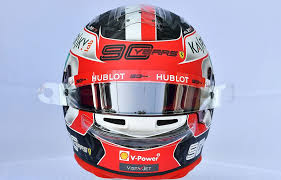
Crash Helmets: Head and neck injuries remains the greatest single injury risk to drivers. A driver’s head is subjected to extreme G-forces experienced during accelerating and braking with a high-speed car. Crash helmets are compulsory in F1 racing since 1953.
A modern F1 helmet is very light weighing around 1.3 kilos and are very strong. The stronger the helmet, the greater is its ability to absorb impacts and resist penetration during a crash.
They are mainly made up of carbon fibre, polyethylene and fire-resistant aramide, and are constructed in several layers. The helmet’s visor is also made up of fire-resistant polycarbonate providing excellent visibility.
Drivers use tinted visors that are coated with anti-fogging chemicals that prevent the accumulation of mist during rain. Several transparent strips are attached outside the visor that drivers can peel off to clear their vision to remove the dirt accumulating in the visor during the race.
Adequate and filtered ventilation is also provided in the helmet for breathing. The helmets are aerodynamically designed to minimise drag. HANS: To keep the car’s centre of gravity as low as possible, the bottom of the seat is on the floor of the chassis, just inches above the ground. In the event of an accident, Head and Neck Support (HANS) is intended to prevent stretching of the vertebrae and to prevent the driver’s head from colliding against the steering wheel.
HANS consists of a shoulder collar made up of carbon fibre that is attached to the shoulder of the driver. HANS has been made compulsory since 2003.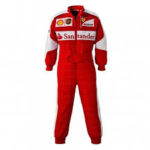 Clothing: Driver suit is made up of fire-resistant, a lightweight artificial fibre called Nomex. It can withstand a temperature of 840 degrees Celsius for 11 seconds. These suits are also worn by pit crews. Under the helmet drivers wear a balaclava made of the same material.
Under the suit, the driver also wears flameproof underwear. Ankle boots are made of soft, cushioned leather is also fire-resistant; the gloves are also fire-resistant and made up of the same artificial fibre. The driver must wear a biometric glove during driving.
F1 car must be fitted with an FIA accident data recorder during each Event and during all tests which are attended by more than one team.
F1 race takes place according to a pre-determined schedule, over a weekend. It takes place through a period of 3 days Friday, Saturday and Sunday.
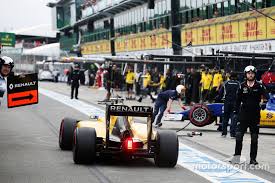 Pits Selection: Generally the winning constructor from the previous year picks which end of pit lane they want, at some tracks driver can get an advantage by being last in pit lane but most of the time driver gains the advantage from being first and so that they don’t have another team in the way when driving into the pit box, and all the remaining teams are ordered from them based on the previous year’s Constructors results.
On Friday before every F1 Grand Prix (except Monaco), there are two 90-minute practice sessions. Monaco has them on Thursdays. Teams use them to work on setups and strategy choices for the coming weekend, while the drivers get an opportunity to learn or re-familiarize themselves with the circuit.
On Saturday, begins with the 3rd practice session in the morning, the duration of this session is one hour. Saturday afternoon the teams have a one-hour qualifying session divided into three parts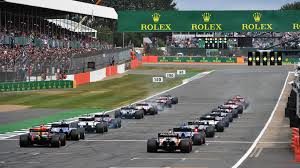
Q1: During qualifying session 1, all the participating cars try to set the fastest time. The five slowest cars are eliminated, earning the bottom grid positions.
Drivers are allowed to complete as many laps as they want during this short space of time that lasts 18 minutes. They are positioned 16, 17, 18, 19 and 20 on the starting grid based on their fastest timings.
Q2: This session lasts 15 min after a brief period of the interval, where the remaining 15 cars participate and try to set the fastest time. The five slowest cars are eliminated. They are positioned 11, 12, 13, 14 and 15 on the starting grid based on their fastest timings.
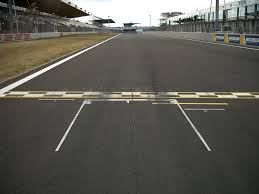 Q3: The duration of this session if of 12 min and the remaining 10 cars participate in this session. The final grid standing of these 10 cars is based on the fastest timings set in this session. The driver finishing the fastest amongst them all is awarded the pole position, which is the first position of the grid.
Race: F1 race takes place on Sunday afternoon. The race starts with a warm-up lap, drivers drive the car along the race track in slow speed to ensure that track conditions are safe and handling of the car. This lap is also used to build up tyre temperatures.
Once all the cars have taken their positions on the grid with their engines running, the race begins with the five pairs of lights turning green one after another after 1 sec each. When all five pairs of lights turn green the race begins.
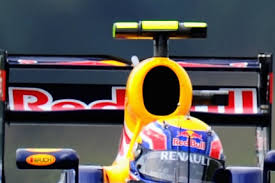 DRS: F1 car needs downforce to keep the cars on the track in the corners. When cars accelerate through the straight line, the additional speed creates much more downforce than required.
DRS (“Drag Reduction System”), enables a car to open its rear wing to control the downforces on the car. This increases performance and helps in passing. This system is activated by the driver through a button on the steering wheel. During the race, DRS can only be used in designated Activation Zones.
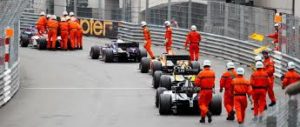 F1 event is supervised by six delegates nominated by FIA for each race they are:
- Safety delegate.
- Medical delegate.
- Technical delegate.
- Press delegate.
- A representative of the President of the FIA.
- An observer.
- A safety car driver.
- A medical car driver.
The following FIA officials who are holders of an FIA Super License are also present at the race
- Three stewards one of whom is appointed chairman.
- A race director.
- A permanent starter.
- The clerk of the course.
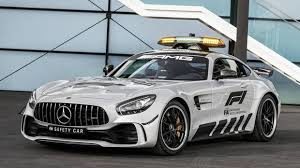
The F1 safety car is driven by an FIA appointed driver and carries an FIA observer capable of recognising all the competing cars who is in permanent radio contact with race control.
Fifty minutes before the start of the formation lap the safety car leaves the pit lane and take up the position at the front of the grid and remain there until the five-minute signal is given, during which it covers a whole lap of the circuit and take up the position.
The safety car may be brought into operation to neutralise a race upon the order of the clerk of the course in consultation with the race director. It is used only if competitors or officials are in immediate physical danger on or near the track but the circumstances are not such as to necessitate suspending the race.
FIA light panels’ displays “SC” and all marshal’s posts displays waved yellow flags and “SC” boards for the duration of the intervention. No car may be driven unnecessarily slowly, erratically or in a manner which could be deemed potentially dangerous to other drivers or any other person at any time whilst the safety car is deployed.
This applies whether any such car is being driven on the track, the pit entry or the pit lane. The safety car joins the track with its orange lights illuminated and does so regardless of where the race leader is.
Each competing cars must reduce speed and form up in line behind the safety car no more than ten car lengths apart. To ensure that drivers reduce speed sufficiently. Cars are not normally allowed to pass the safety car or other competitors during a caution period, and the safety car leads the field at a pre-determined safe speed.
The safety car has been supplied by Mercedes-Benz. It is a 577-horsepower AMG GT R machine. It is equipped with radio systems, fully integrated iPads and WLAN hotspots to ensure constant contact with race control throughout a Grand Prix weekend.
Driven by Bernd Maylander a former successful touring-car racer. He maintains the pace during the safety period just high enough so that the F1 cars’ tyres and brakes do not cool down too much.
Flags play an important role in visually communicating messages quickly and efficiently to the race drivers. Although the radio could theoretically perform the same task, flags are much easier to use to communicate these certain universal messages to the drivers like the race start or finish, lap indication, bad weather indication, etc.
Race Marshal raises the flags to alert the driver of the upcoming dangers so that they can take proper action. Though some race tracks employ lights to supplement the flags, they have remained constant since the early years of racing.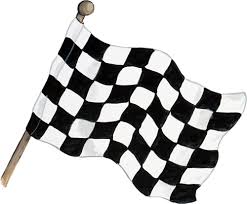 Checkered Flag: A checkered flag is waved indicating the end of a race. The race leader is shown the checkered flag at the end of the race. The checkered flag is also waved at the end of the allotted time during practice and qualifying sessions which indicates the end of the session.
 Yellow Flag: This flag warns drivers to slow down due to some obstacles on the track. During the yellow flag period, overtaking is prohibited.
 Green Flag: This flag gives an all-clear signal to the driver and continues with racing. It also indicates that the potential danger has been removed.
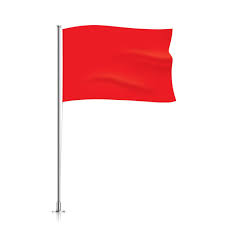 Red Flag: The race or the session is being stopped due to some accident or poor track conditions.
 Blue Flag: This flag is an indication that the driver is about to be lapped by a faster car which is ahead of cars current position. Driver must allow the faster car to overtake him. Overlooking 3 blue flags, driver risks to be penalized.
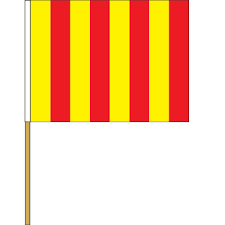 Yellow And Red Striped Flag: The track surface is slippery due to oil spill or water.
 Black With Orange Circle Flag: This flag warns a driver that he has a mechanical problem and must return to his pit. This flag is rarely shown these days the message is directly communicated to the driver through radio.
 Black Flag: This flag is used as a signal to the driver that he has been excluded from the race, and that the driver should immediately return to his pit.
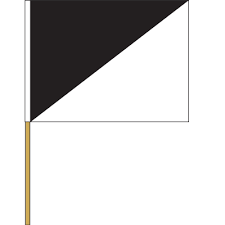 Half Black And Half White Flag: This flag warns the driver of unsporting behaviour.
 White Flag: Warns racing drivers of a slow-moving car on track which can be ambulance or firefighters.